PCC Logo

Community Council

of the Royal Burgh of Peebles & District

PCC Logo

Community Council

of the Royal Burgh of Peebles & District

PCC Logo

Who we are

Peebles and District Community Council (PCC) is governed by the Scottish Borders Council (SBC) Scheme for Community Councils (see boundary maps). Read our constitution and standing orders.

We are local people with an interest in our community. Our 18 members may serve for up to 3 years before standing for re-election. We regularly co-opt members for their skills and to fill vacancies.

The six elected Scottish Borders Councillors from East and West Tweeddale are `ex-officio' (non-voting) members who provide a valuable link to and from SBC.

What we do

Our main role is to:

SBC has a responsibility to

  • Consult with PCC about how local services are delivered
  • Inform us of changes to services & issues that may affect our area
  • More info in SBC's Community Council Training Handbook

When & where we meet

Ordinary Meetings of the Council are held on the Second Thursday of each month in the Burgh Hall, Peebles. These meetings normally start at 7:00pm and continue until approximately 9:00 pm.

Our meetings are publicised in the Peeblesshire News the week before the meeting with any changes to time and venue advertised.

Minutes and reports

Minutes and reports from the chair, planning convenor and police are available in Documents.

There is also a copy of the minutes and agenda displayed on the Community Council Noticeboard each month. The board is situated on the right of the archway leading to the Chambers Institution and Quadrangle. A further copy is located in the library. Please ask the librarian for the Community Council folder.

Next ordinary meeting

7pm Thursday 12th September 2024Agenda

Come along

All meetings are open to the public.

Each meeting allows 10 minutes for a Question and Answer session for members of the public to ask a question on any subject of relevance to the community council.

Citizen Space – Consultations

Contribute your views on open consultations and find out what changed in response to previous consultations for SBC Citizen Space and Scottish Government consultations. On each site you can scroll down to "see all open consultations".

Tweed Bridge in Peebles over flooded river with anxious people milling about

This was the view from Tweed Bridge, Peebles on 30 December 2015, when 631 tonnes of water flowed past the bridge every second. Just think what an extra 515 tonnes of water every second would look like. That’s what SEPA says Peebles needs to prepare for.

In fact, every town and village along the Tweed must prepare for peak flows 59% greater than the highest flood on record. In Peebles, that peak was 721 tonnes per second on 7 January 1949, meaning we need to prepare for 1146 tonnes/sec. The guidance applies across the Borders to settlements on every Tweed tributary with a catchment over 50 km2 – including Eddleston Water.

Tweeddale Flood Advisory Group have issued a call for urgent action for SBC to strengthen flood defences in Peebles now that the Hawick, Selkirk and Galashiels defences are complete.

The critical question is: are SBC planning decisions protecting the public from climate change? 32 hectares of fields East of Cavalry Park are allocated for housing and mixed use in the Local Development Plan (LDP). Yet SEPA’s latest flood maps show that almost the entire site has a high and frequent flood risk of ≥10% each year. Hopefully this land will be removed from the next LDP.

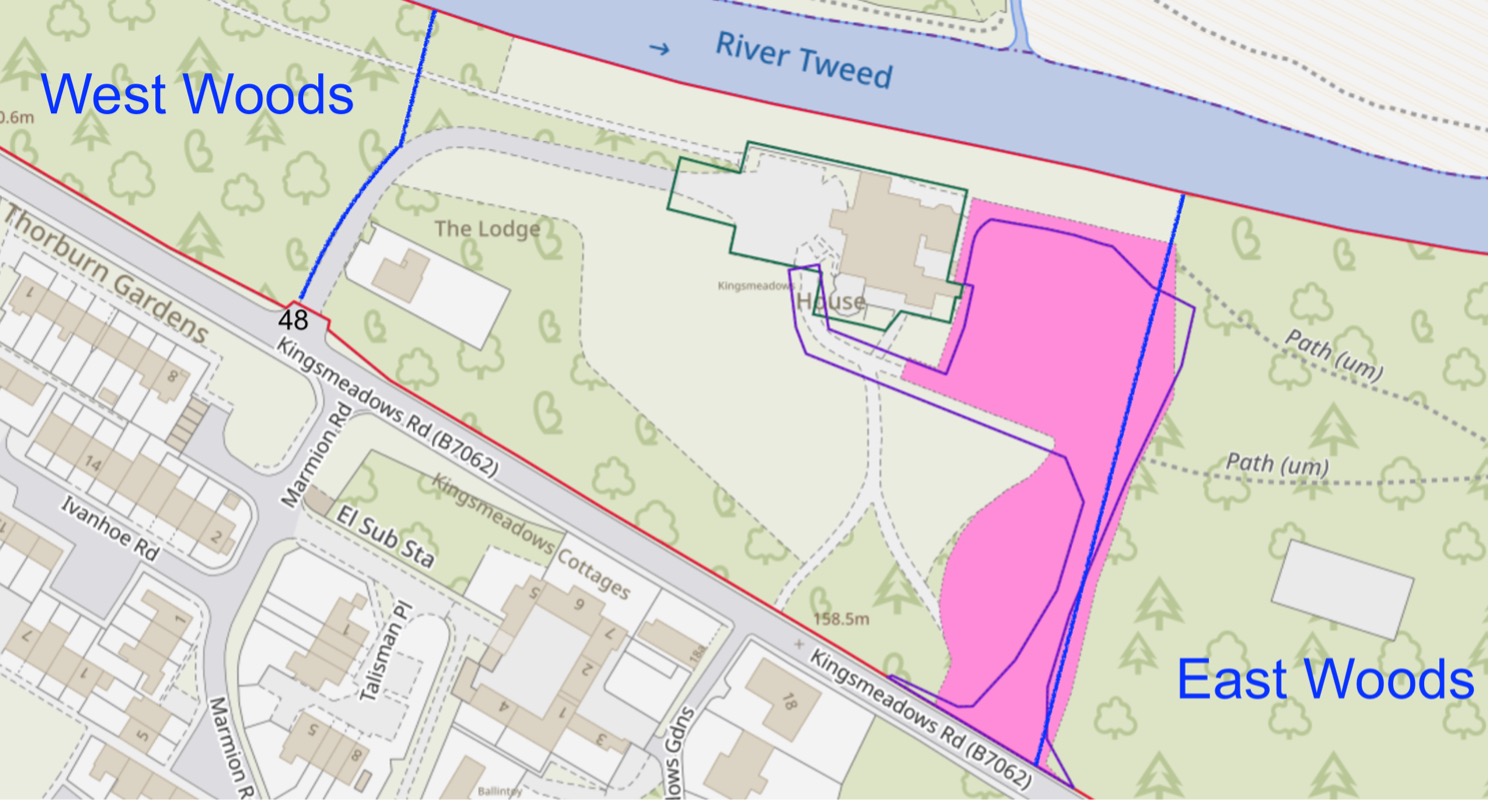
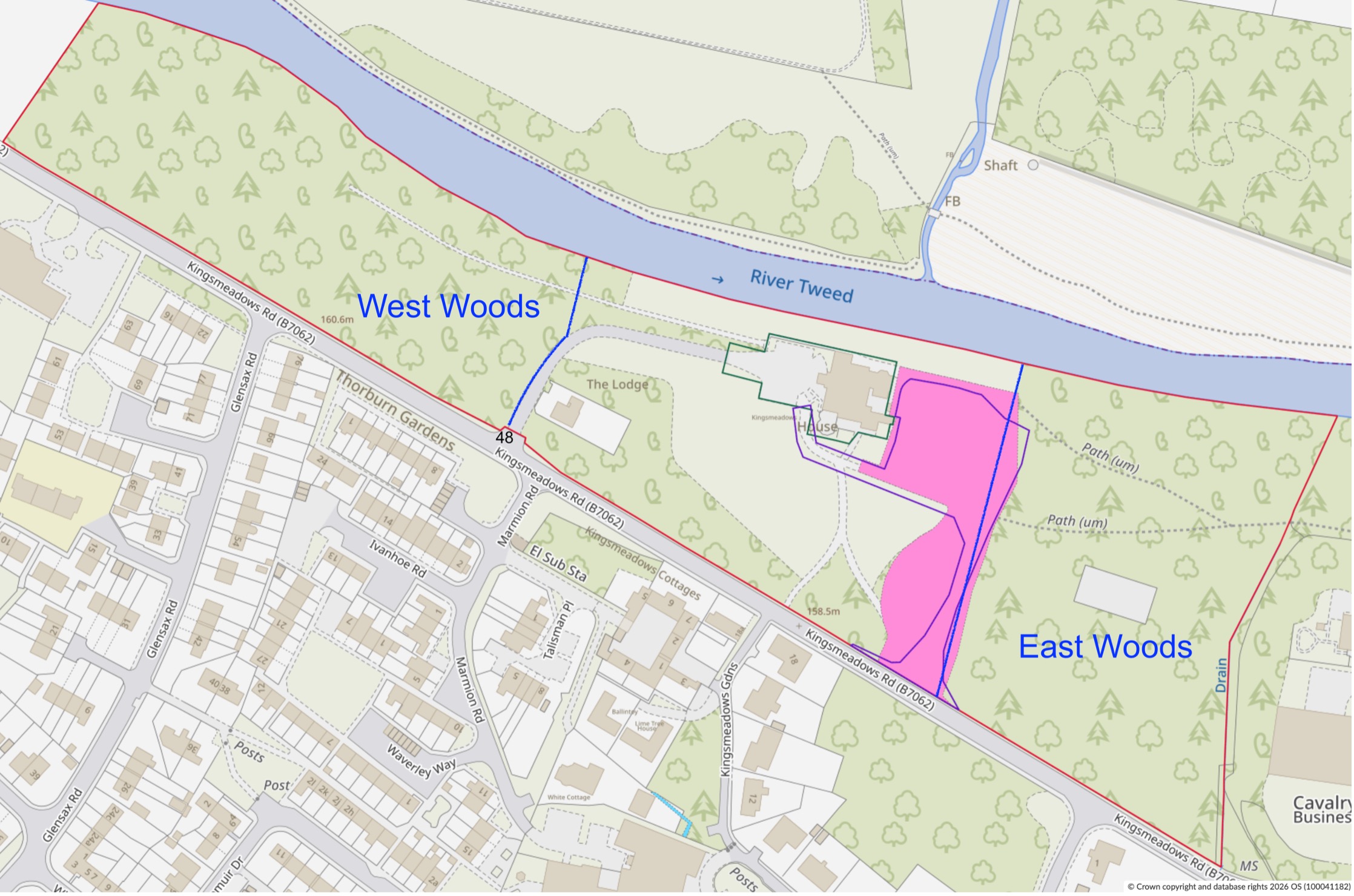
The picture below shows Kingsmeadows House on 9 February 2020. The river peaked at 235 tonnes/sec – the 27th largest flood on record. The woodland on the left is the site of proposed flats which were approved in 2016 and 2021 – despite encroaching into the floodplain.

The reality of climate change, according to SEPA, is that Kingsmeadows must prepare for peak floods with 910 tonnes/sec more than shown in the photo below. It’s clear just how damaging and dangerous that would be – and why building in the flood plain is against planning policy.

Despite this, the developer is appealing. They want their expired permission renewed for 5 years, again in the floodplain. They ask SBC to grant approval without reconsidering the principle of the development because, in the developer’s view, policies haven’t materially changed. They do not provide an updated Flood Risk Assessment.

In reality, new Local and National planning policies have been issued and SEPA guidance shows the flood risk has more than doubled, from 500 tonnes/sec when last approved to 1146 tonnes/sec today. SBC now no longer have discretion to approve development within the floodplain or ignore climate change guidance without triggering escalation to Scottish Ministers.

We hope SBC considers flooding, ecology and trees when they hear this appeal on 23 Feb 2026.

Dr Michael Marshall
Planning Convenor
Peebles & District Community Council

As always: support or comment to Anne Snoddy (Secretary PCC)

Flooded River Tweed lapping near the top of bank and woodland with Kingsmeadows House in background

Articles/20260200.html

Now SBC's Chief Financial Officer (CFO) has commented, this follow-on from PCC's June 2025 Live Borders (LB) briefing (see News/20250612.html) will be considered at PCC's 7pm Thu 12 Feb 2026 meeting (see our email and her reply).

SBC meeting 29 Oct 2025

SBC's 29 Oct 2025 meeting considered this LB report by SBC Director Resilient Communities and LB CEO containing up-to-date financial figures for LB:

"7.11 Since 2019 Scottish Borders Council has provided Live Borders with budgeted Management Fees, capital investment and additional, one-off payments. Members will be aware that as well as the budgeted management fee, additional payments of £6m have been approved by Council since 2022/23 to address the increased costs detailed above and maintain Live Borders position as a going concern."

However, the financial figures do not match the commentary. For example, £1m of the £6.384 “additional payments” is a loan.

Even when ignoring the impact of inflation, except for a single year in 2024, every year since 2016 shows a decrease in the management fee SBC paid to Live Borders – even when including the "additional payments" (fig. 1).

Live Borders Management Fee Nominal 2016–25 1. LB mgt fee nominal 2016–25

The real picture is very different. Inflation must be taken into account when comparing financial figures across years. Adjusting the management fee for inflation (to the equivalent in 2016£) we see a very different picture (fig. 2).

We see a steady and substantial decrease in the management fee offered to LB (blue), reducing by 45% (almost halving) compared with 2016. Even when including "additional payments" (orange), the average reduction in those years compared with 2016 is 25%.

Live Borders Management Fee Real 2016–25 2. LB mgt fee real 2016–25

The claim that LB has received "substantial additional funding" is not true in real terms (adjusted for inflation) – and is only true in nominal terms (ignoring inflation) in 1 out of the past 8 years.

SBC meeting 20 Nov 2025

SBC's 20 Nov 2025 meeting to decide LB's future considered this report by SBC Director Resilient Communities and LB CEO containing multiple references to LB being financially unsustainable and having received substantial additional funding in recent years.

Responding to Cllr Begg, SBC CFO Suzanne Douglas said

“I think the numbers will show that we’ve not in any way provided a disproportionate reduction over the years to the Live Borders funding, but actually, certainly over the shorter term provided significant additional funding.”

In fact, SBC’s latest financial figures show that even after “significant additional funding”, the Live Borders management fee has substantially reduced since 2016, with the baseline management fee currently 55% of the 2016 figure in real terms.

The report on Live Borders' future was approved (with Cllrs Tatler & Pirone's amendment to consider CATs).

What do you think?

Read the full PCC Briefing.

Please send your feedback to secretary@ccrbpeebles.co.uk or tell us in person at the PCC Meeting 7pm Thu 12 Feb 2026

News/20260131.html

Peebles

With flooding and wind farms in the news, we're sharing the latest climate and biodiversity updates.

SEPA's latest climate change allowances for flood risk assessment land use planning sets 59% as the climate change allowance for Flood Risk Assessments for developments on the Tweed Catchment. New developments must be outwith the flood area not just of the largest flood on record, but outwith the flood area modelling an additional 59% flow on top of the historic peak.

SEPA's guidance is based on the latest Climate change trends and projections from Adaptation Scotland, using climate modelling from the Met Office and others.

Met office prediction for warming in Peebles 1. Peebles warming (Met Office)

UK Climate Projections (UKCP) for Peebles are shown in fig 1.

UKCP data are relative to 1990, so if we want to compare Met Office predictions against the 2015 Paris Agreement ambition to hold global warming within 1.5°C above pre-industrial levels, we need to add around 0.6°C (Paris Agreement FAQ pg 8)

Paris Agreement FAQ How close are we to 1.5°C 2. Paris Agreement FAQ How close are we to 1.5°C?

United Kingdom

On 20 Jan 2026, the Department for Environment, Food & Rural Affairs published their National security assessment on global biodiversity loss, ecosystem collapse and national security.

The report makes sobering reading, offering 7 key judgments:

1. Global ecosystem degradation and collapse threaten UK national security and prosperity (high confidence).

2. Cascading risks of ecosystem degradation are likely to include geopolitical instability, economic insecurity, conflict, migration and increased inter-state competition for resources (moderate confidence).

3. Critical ecosystems that support major global food production areas and impact global climate, water and weather cycles are the most important for UK national security (high confidence).

4. Ecosystem degradation is occurring across all regions. Every critical ecosystem is on a pathway to collapse (high confidence).

5. There is a realistic possibility that some ecosystems (such as coral reefs in South East Asia and boreal forests) start to collapse from 2030, and others (rainforests and mangroves) start to collapse from 2050 (low confidence).

6. All countries are exposed to the risks of ecosystem collapse within and beyond their borders (moderate confidence).

7. Without significant increases in UK food system and supply chain resilience, it is unlikely the UK would be able to maintain food security if ecosystem collapse drives geopolitical competition for food (moderate confidence).

Read DEFRA's full National security assessment

Global

Is it too late to keep global warming below 1.5°C? The challenge in 7 charts

Nature, 21 Nov 2023.

This immersive special feature visually explains the current state of the climate crisis.

"Chances are rapidly disappearing to limit Earth’s temperature rise to the globally agreed mark, but researchers say there are some positive signs of progress."

"At first glance, it seems that nations have no chance of meeting the Paris agreement’s headline goal of limiting warming to 1.5°C. The rate of warming has picked up over the past decade, and the average global temperature for 2023 is likely to be 1.4°C above the average for 1850–1900."

Exceptional Warming Spike in 2023–24, source Berkeley Earth 1. Exceptional Warming Spike in 2023–24 (Berkeley Earth)

Read Nature's full Article

Exceeding 1.5°C requires rethinking accountability in climate policy

Nature comment, 26 Jan 2026.

"In 2024, global average temperatures exceeded 1.5°C for the first time. Going above 1.5°C in one year does not mean that the Paris threshold itself is technically breached — it is defined as an average over at least 20 years to account for year-to-year variations — but it indicates that the world is on track to pass it in a decade or less.

In July, an advisory opinion from the International Court of Justice firmly anchored 1.5°C as the primary limit of the Paris agreement, reducing ambiguity over its aim. Although severe negative effects of climate change materialize below 1.5°C, this limit demarcates the minimum threshold of dangerous human interference that governments agreed as unacceptable.

In an ‘overshoot’ world – one in which global warming exceeds 1.5°C but is later brought back below this limit – countries’ obligations to meet this temperature limit remain. However, the pursuit of the 1.5°C limit from above poses further challenges.

Countries will need to commit not only to reach net-zero carbon dioxide emissions, but also to achieve and sustain net-negative emissions — by removing billions of tonnes of CO2 from the atmosphere and durably storing it. They will need to confront the further loss and damage and the adaptation needs that arise as a result of exceeding the 1.5 °C limit. And governments need to ask why they failed to prevent dangerous human interference, and who is responsible."

Read Nature's full Article

Bending the curve of terrestrial biodiversity needs an integrated strategy

Nature, 10 Sep 2020.

statistics:The next 30 years will prove pivotal for Earth’s biodiversity 2. DEFRA assessment figure pg 5

This article explains the image on page 5 of DEFRA's security assessment.

"Increased efforts are required to prevent further losses to terrestrial biodiversity and the ecosystem services that it provides. Ambitious targets have been proposed, such as reversing the declining trends in biodiversity; however, just feeding the growing human population will make this a challenge. Here we use an ensemble of land-use and biodiversity models to assess whether—and how—humanity can reverse the declines in terrestrial biodiversity caused by habitat conversion, which is a major threat to biodiversity."

Figure 1e shows estimates of "the global number of species not already extinct or committed to extinction (measured using the fraction of globally remaining species metric)."

Read the full article courtesy of the International Institute for Sustainability

Article feedback secretary@ccrbpeebles.co.uk

News/20260130.html

South of Scotland Enterprise have launched a public consultation on proposals to create a South of Scotland Standard for Community Benefits from onshore wind.

The draft South of Scotland Standard includes nine key principles:

  • High-quality community engagement from first point of contact
  • A standardised minimum payment of £5000 per installed MW per year (index-linked)
  • Transparency and accountability
  • Local flexibility in how funds are used
  • Investing in community capacity
  • Contractual security for agreements
  • Tackling barriers to shared ownership
  • Retrospectivity for older agreements
  • A voluntary charter mark for developers

PCC comment

PCC recently supported the Scottish Coalition on Community Energy call for higher community benefits from clean energy

"For onshore wind, they suggest £7.3k per Megawatt per year, plus additional payments to bring the total to at least 2.5% of the developer’s revenue from the project."

Read more and have your say

Article feedback secretary@ccrbpeebles.co.uk

News/20260129.html

This is the Planning Convenor's report of – and personal opinions on – the issues raised at the Sat 17 Jan 2026 South of Scotland Community Council convention on wind farms, for consideration by PCC at its next meeting, 7pm Thu 12 Feb 2026.

For background on the convention, see this BBC article.

Key takeaways

CCs feel overloaded & outgunned

  • Some CC’s have had up to 10 applications for wind farms or batteries (BESS) in their area
  • The workload for a CC to deal with one application is substantial (many large reports, written by multiple consultants)
  • The workload to deal with multiple applications is unsustainable
  • The same applications keep coming back until approved

NPF4 policy 11 Energy gives green light to wind farms & batteries

  • Renewable energy proposals outside National Parks and National Scenic areas will be approved
  • Long list of negative impacts are listed, but developers only need say how they will mitigate those
  • Significant weight must be given to renewable energy generation and greenhouse gas targets

Current trajectory

  • Many wind farms and overhead lines across Borders
  • With only small concessions to protect landscape and biodiversity
  • Calls for increased community benefits (for an update on Leithenwater wind farm see News/20260126.html)

Key ask

Does PCC wish to sign the Unified Statement (changing “Highlands" to reflect wider geography) and join a Scotland-wide Community Council movement to push back against the impact of unplanned and disproportionate renewable energy infrastructure?

Read the full summary from the convention organisers.

Planning Convenor's comments

There was a call for a (non-binding) show of support and I indicated Peebles' likely support

  • Items 2 & 3 obviously needed
  • Moratorium (item 4) would only cause delay if much needed strategy is missing.
  • Item 1 is less clear. Wording is agreeable by all – but PCC must decide whether renewable energy rollout is "unjust and unnecessary industrialisation" in light of the climate and biodiversity emergencies.

See News/20260130.html for an update on the Government's latest warnings on climate and biodiversity.

There is a plan for renewable energy infrastructure rollout from the National Energy System Operator (NESO). Current plans show much more renewable energy being delivered than the UK needs – despite a recent review by NESO. This plan might be unstoppable given the cost, lead time and societal need to transition to renewable energy.

There have also been calls to use the convention to address the environmental damage done (and the money being funelled into private investors) by forestry, e.g. Stobo Hope and Todrig.

These problems can be seen as indicative of systemic inequality and wider failures of planning democracy.

Dr Michael Marshall
Planning Convenor

Please send your feedback to secretary@ccrbpeebles.co.uk or tell us in person at the PCC Meeting 7pm Thu 12 Feb 2026

News/20260122.html

At the time of writing, some vulnerable communities further down the River Tweed such as Hawick (£140m), Selkirk (£31m) and Galashiels (£3.6m) have had their flood defences strengthened. However, Peebles has not.

The JBA report commissioned on behalf of Scottish Borders Council identified the issues and made recommendations after Storm Frank, 10 years ago. Peebles is very vulnerable and urgent action is required, hopefully before the next serious weather event.

Promises have been made regarding temporary flood barriers, but further flood flow assessments require to be conducted, these require to be done ASAP. The TFA Group, Peebles Resilience Group and Peebles Community Council calls upon our elected representatives to now take this issue up with SBC, Scottish Ministers and others.

Communities are being proactive and doing everything possible with the resources provided. However, Peebles requests at least the same level of support already provided to communities further downstream.

Postscript

Since the JBA report was produced a great deal of additional analysis and research has been done. This has resulted in upgraded forecasts and newly published guidance. Much of this being introduced in the last twelve months. This new guidance includes from SEPA “Climate change allowances for flood risk assessment in land use planning”. This is now version 6 dated 25 February 2025.

Historically, SEPA recommended a universal 20% allowance in increased flow for climate change. However, in the light of the latest data and analysis, for the River Tweed this has now been increased to an uplift of 59% (JBA report used 33%).

The historical data shows that the January 1949 floods recorded a river height of 4.115 m above normal with a flow of 721 m3/S. This is considerably higher than Storm Frank in 2015 which was 3.654 m above normal with a peak flow of 631.1 m3/S. Even increasing the storm Frank flows potentially by 59% should give us all cause for concern.

Read the full report

Colin Kerr
Chairman, Walkerburn Community Council
Leader, Tweeddale Flood Advisory Group

Paul Spence
Leader, Peebles Flood Resilience Community Group
Member, Tweeddale Flood Advisory Group

Peter Maudsley
Chairman, Peebles and District Community Council
Member, Tweeddale Flood Advisory Group

Tweeddale Flood Advisory Group Facebook

Article feedback secretary@ccrbpeebles.co.uk.

News/20260120.html

Planners recently told Granton Homes their Kingsmeadows application would be refused. Before a decision was issued, they appealed.

Peebles Community Council has submitted a comprehensive objection setting out why the community believes the proposal breaches 22 planning policies – NPF4 policies 1, 3, 4, 6, 7, 8, 9, 16, 20 and 22; and LDP2 policies EP1, EP2, EP3, EP9, EP10, EP11, EP12, EP13, EP15, IS8, PMD2 and PMD5.

Expert reports

We wish to thank two qualified experts for volunteering their time and expertise to provide expert assessments on behalf of our community.

The impact to trees and the woodland was assessed by a retired Chartered Arboriculturalist and former Registered Consultant of the Institute of Chartered Foresters with 40 years forestry and arboriculture experience, specialising in trees and planning matters for over 30 years. Read the full arboriculture report.

The ecological impact was assessed by a Chartered Environmentalist, Member of the Chartered Institute of Ecology and Environmental Management (CIEEM) and professional ecologist with 30 years’ experience of assessing the ecological impact of development proposals in the Scottish Borders. Read the full ecology report.

Issues

Granton request renewed permission – with reduced protection for the woodland.

  • Condition 7 is vital protection for this woodland in the Peebles Conservation Area on the Tweed Special Area of Conservation (SAC).
  • NatureScot and SBC’s ecologist agree that Condition 7 is necessary for the European Protected Species (EPS) in the Tweed.

The issues seem fundamental.

  • This proposal for luxury flats does nothing to alleviate SBC’s affordable housing emergency.
  • The proposal fails many policies, for example the three veteran and 37 notable trees that would be at risk breaches NPF4 policy 6.
  • The applicant provides no ecological or other expert reports to support this application – the reports available expired years ago and can’t be relied on for this decision.
  • We now know that flood levels in the Tweed are half a metre higher than previously believed; this proposal breaches LDP2 policy IS8 by being in the flood plain and doesn’t provide a competent Flood Risk Assessment.

We ask that this appeal be dismissed and permission refused.

More Save Kingsmeadows

Article feedback secretary@ccrbpeebles.co.uk.

News/20251228.html

Dear community partners,

I’m getting in touch from the Returning Officer’s team to share an Open Letter: Invitation to Engage, Accessibility at Elections and to warmly invite your support.

We’re committed to making elections across the Scottish Borders as accessible, inclusive and welcoming as possible. As a first step in a wider engagement programme, we want to listen to people who may face barriers to voting and shape our plans around what we hear.

  • Please share the open letter with the people you support—especially anyone who has experienced barriers to voting (e.g., sight loss, deafness/BSL needs, mobility challenges, neurodivergence, learning disabilities, mental health difficulties, or other access needs).
  • Encourage people to contact us directly. We’d like to hear first‑hand about what would make voting easier—from polling station accessibility and transport to information formats, communication support, and any other part of the process.
  • Tell us the best way to engage. We can host in‑person sessions, set up digital meetings, or visit groups so we can listen and learn together.

How to get in touch:
elections@scotborders.gov.uk
Phone: 01835 826556
Post: Returning Officer, Council Headquarters, Newtown St Boswells, Melrose TD6 0SA

Warm regards,

Declan Hall
Democratic Services Team Leader
Scottish Borders Council
Tel: 01835 826556

Article feedback secretary@ccrbpeebles.co.uk.

News/20251217.html

Members of the public attending our 13 Nov meeting complained that SBC appeared not to be following important environmental regulations – potentially illegally – and asked us to raise a complaint with SBC.

This follows the Environmental Rights Centre for Scotland (ERCS) recently writing to SBC expressing their view that approval of the Kingsmeadows applications without appropriate environmental assessment – as planners said they were minded to do – would be grounds for judicial review arising from breach of Habitats Regulations.

SBC declined to publish the correspondence with ERCS on the planning portal, despite a request to do so. Members of the public also asked PCC to repeat the request to publish the correspondence with ERCS.

We complained that

  • SBC appears to be failing legal duties to safeguard European Protected Species (EPS)
  • Failures appear to stem from a misunderstanding of the law
  • Legal advice from ERCS appears to be being ignored
  • Legal concerns haven't been published on the planning portal and remain unanswered
  • Regulations require proof of no impact to EPS – beyond scientific doubt, based on data
  • Yet planners say they are minded to decide without appropriate environmental assessment

We ask SBC to immediately

  • Reject these applications
  • Or pause them while the legal complaints are investigated.

Read our complaint to SBC here.

Add your complaint

If you share our concerns, we ask that you complain to SBC as well.

Complaints can be made:

Article feedback secretary@ccrbpeebles.co.uk.

News/20251117.html

News archive