
Community Council
of the Royal Burgh of Peebles & District
Community Council
of the Royal Burgh of Peebles & District
Peebles
With flooding and wind farms in the news, we're sharing the latest climate and biodiversity updates.
SEPA's latest climate change allowances for flood risk assessment land use planning sets 59% as the climate change allowance for Flood Risk Assessments for developments on the Tweed Catchment. New developments must be outwith the flood area not just of the largest flood on record, but outwith the flood area modelling an additional 59% flow on top of the historic peak.
SEPA's guidance is based on the latest Climate change trends and projections from Adaptation Scotland, using climate modelling from the Met Office and others.
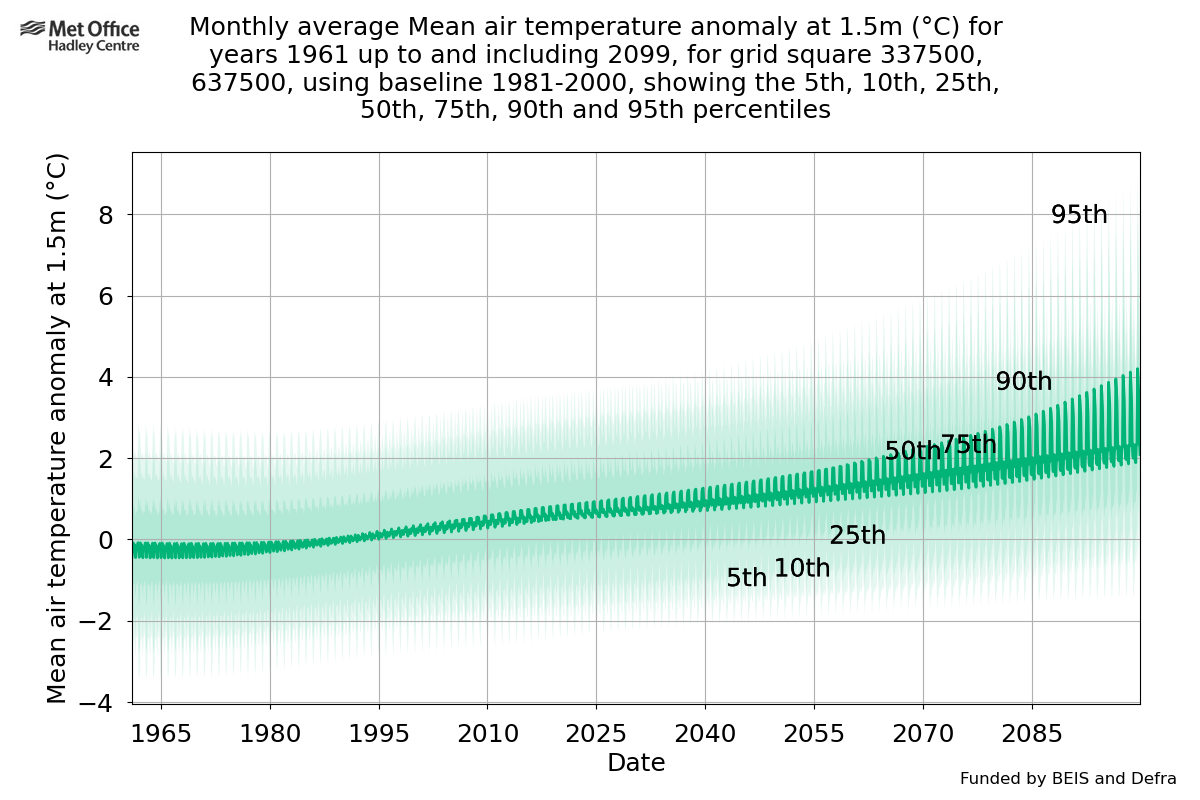
UK Climate Projections
(UKCP) for Peebles are shown in
UKCP data are relative to 1990, so if we want to compare Met Office predictions against the 2015 Paris Agreement ambition to hold global warming within 1.5°C above pre-industrial levels, we need to add around 0.6°C (Paris Agreement FAQ pg 8)
United Kingdom
UK facts & figures
The UK emits 0.83% of global energy related CO2 emmissions, according to the International Energy Agency (IEA).
"On a historical scale, the UK is in the top ten for cumulative emissions since the nineteenth century, reflecting its early industrialisation." [Carbon Copy]
13.58% of the UK's final energy consumption comes from modern renewables, ranking the UK
"In 2024 alone, China added 277 GW of solar power and 80 GW of wind, in contrast to 2.7 GW of total renewable capacity added in the UK" [Royal United Services Institute for Defence and Security Studies].
DEFRA's warning
On 20 Jan 2026, the Department for Environment, Food & Rural Affairs published their National security assessment on global biodiversity loss, ecosystem collapse and national security.
The report makes sobering reading, offering 7 key judgments:
1. Global ecosystem degradation and collapse threaten UK national security and prosperity (high confidence).
2. Cascading risks of ecosystem degradation are likely to include geopolitical instability, economic insecurity, conflict, migration and increased inter-state competition for resources (moderate confidence).
3. Critical ecosystems that support major global food production areas and impact global climate, water and weather cycles are the most important for UK national security (high confidence).
4. Ecosystem degradation is occurring across all regions. Every critical ecosystem is on a pathway to collapse (high confidence).
5. There is a realistic possibility that some ecosystems (such as coral reefs in South East Asia and boreal forests) start to collapse from 2030, and others (rainforests and mangroves) start to collapse from 2050 (low confidence).
6. All countries are exposed to the risks of ecosystem collapse within and beyond their borders (moderate confidence).
7. Without significant increases in UK food system and supply chain resilience, it is unlikely the UK would be able to maintain food security if ecosystem collapse drives geopolitical competition for food (moderate confidence).
Global
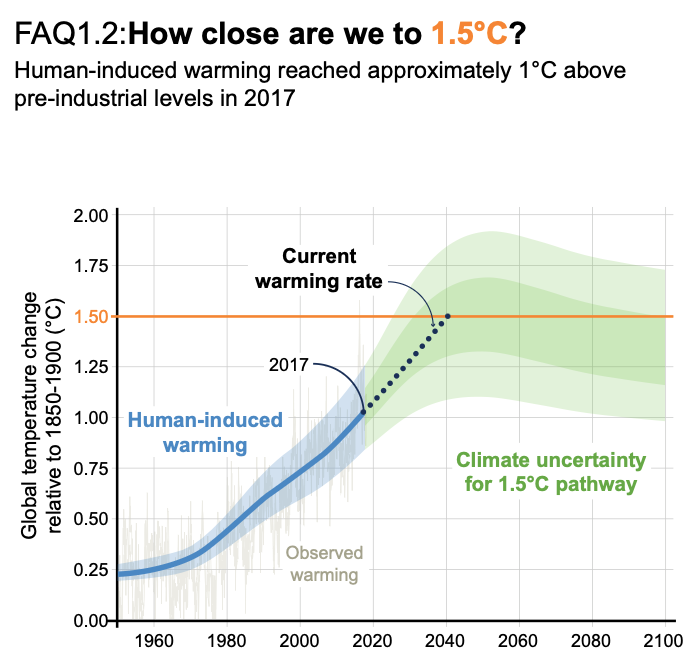
"WMO’s State of the Global Climate report 2025 confirms that 2015-2025 are the hottest 11-years on record, and that 2025 was the second or third hottest year on record, at about 1.43 °C above the 1850-1900 average." World Meteorological Organization State of the Global Climate 2025 23 Mar 2026.
Is it too late to keep global warming below 1.5°C? The challenge in 7 charts
Nature, 21 Nov 2023.
This immersive special feature visually explains the current state of the climate crisis.
"Chances are rapidly disappearing to limit Earth’s temperature rise to the globally agreed mark, but researchers say there are some positive signs of progress."
"At first glance, it seems that nations have no chance of meeting the Paris agreement’s headline goal of limiting warming to 1.5°C. The rate of warming has picked up over the past decade, and the average global temperature for 2023 is likely to be 1.4°C above the average for 1850–1900."

Exceeding 1.5°C requires rethinking accountability in climate policy
Nature comment, 26 Jan 2026.
"In 2024, global average temperatures exceeded 1.5°C for the first time. Going above 1.5°C in one year does not mean that the Paris threshold itself is technically breached — it is defined as an average over at least 20 years to account for year-to-year variations — but it indicates that the world is on track to pass it in a decade or less.
In July, an advisory opinion from the International Court of Justice firmly anchored 1.5°C as the primary limit of the Paris agreement, reducing ambiguity over its aim. Although severe negative effects of climate change materialize below 1.5°C, this limit demarcates the minimum threshold of dangerous human interference that governments agreed as unacceptable.
In an ‘overshoot’ world – one in which global warming exceeds 1.5°C but is later brought back below this limit – countries’ obligations to meet this temperature limit remain. However, the pursuit of the 1.5°C limit from above poses further challenges.
Countries will need to commit not only to reach net-zero carbon dioxide emissions, but also to achieve and sustain net-negative emissions — by removing billions of tonnes of CO2 from the atmosphere and durably storing it. They will need to confront the further loss and damage and the adaptation needs that arise as a result of exceeding the 1.5 °C limit. And governments need to ask why they failed to prevent dangerous human interference, and who is responsible."
Bending the curve of terrestrial biodiversity needs an integrated strategy
Nature, 10 Sep 2020.
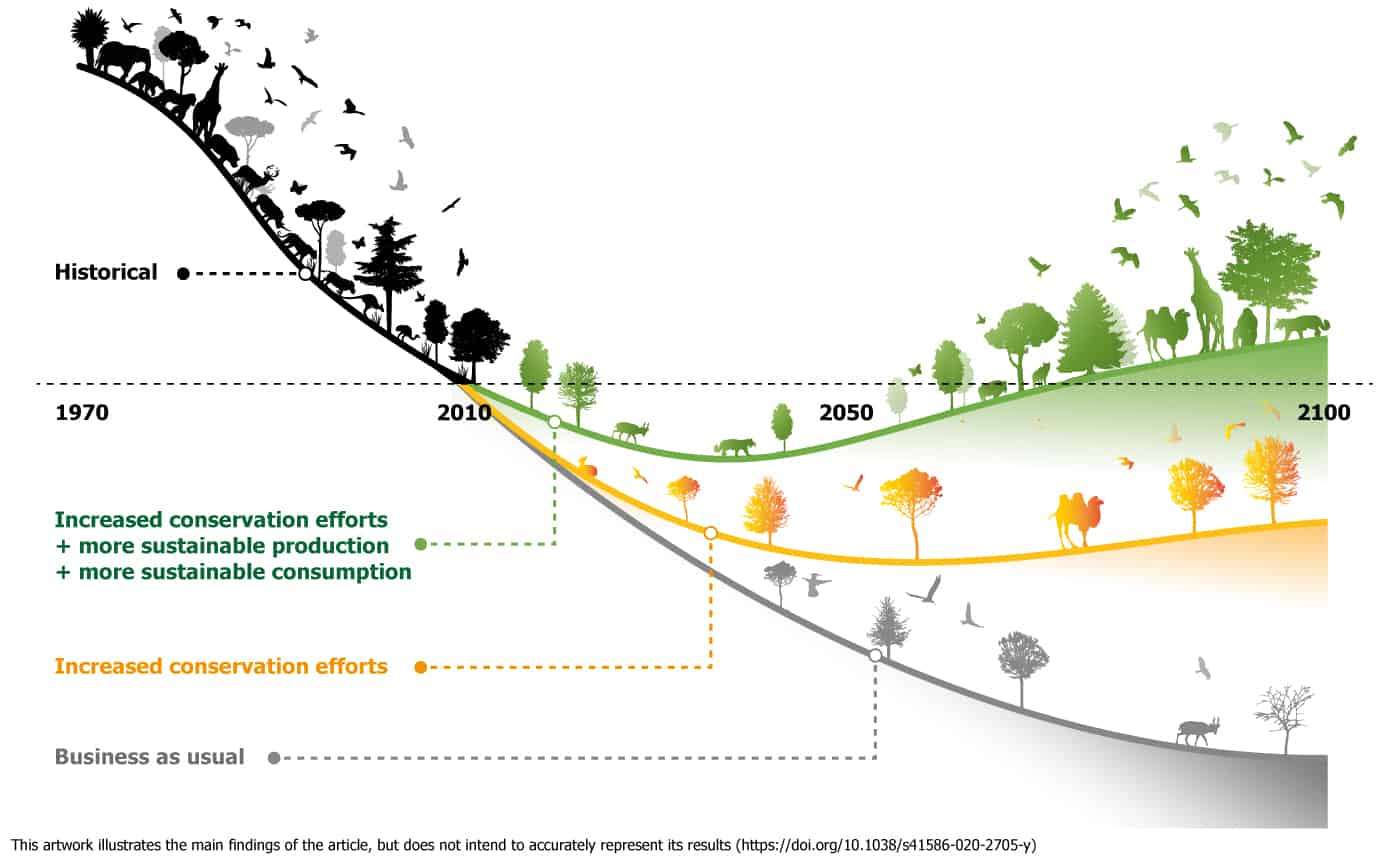
This article explains the image on page 5 of DEFRA's security assessment.
"Increased efforts are required to prevent further losses to terrestrial biodiversity and the ecosystem services that it provides. Ambitious targets have been proposed, such as reversing the declining trends in biodiversity; however, just feeding the growing human population will make this a challenge. Here we use an ensemble of land-use and biodiversity models to assess whether—and how—humanity can reverse the declines in terrestrial biodiversity caused by habitat conversion, which is a major threat to biodiversity."
Figure 1e shows estimates of "the global number of species not already extinct or committed to extinction (measured using the fraction of globally remaining species metric)."
Or
Article feedback secretary@ccrbpeebles.co.uk